We are pleased to share the materials from this year’s Family Law Training Day. Thank you to all who attended!
This event would not be possible without the time and expertise of our speakers, who delivered engaging and informative presentations across a range of key topics in family law. Special thanks to HHJ Gordon-Saker, HHJ Spinks, Patrick Freer and Rebecca Clarke (Regency Chambers), Michael Nwoye (Children and Families Across Borders), Dr Ibrahim Jalloh (Consultant Neurosurgeon), Luke Dickinson (CAFCASS), as well as our own Abigail Robinson, Richard Balchin, Jeffrey Deegan, Laura McGinty, and Joshua Walters of Fenners Chambers.
Embedded above is the video playlist of each presentation. To browse the presentations, click the playlist icon in the top-right corner of the video player.
Please note: due to a technical error, there is no audio for the first part of the first presentation. The audio begins at the time stamp 0:41:41. Please accept our apologies for any inconvenience caused.
You will find links to the individual presentations and speaker materials below:
For some time now, there has been a national shortage of educational psychologists. This is partly due to an increase in demand for EHC Needs Assessments (the legal threshold for an EHC Needs Assessment is relatively low). There is anecdotal evidence that the pandemic, and the home-schooling that went with it, made many parents aware of children’s struggles with learning in a way that they may not have been previously.
A lack of available educational psychologists has become a common reason for delays in completing Needs Assessments of children with suspected SEN.
The shortage of educational psychologists (or EPs) in some areas has been problematic given that almost all children undergoing a Needs Assessment will need to be seen by an educational psychologist.[1] However, a lack of educational psychologists is a resource issue. It does not therefore fall within the justified exceptions for delaying an assessment.
When a request is made for a Needs Assessment, it triggers a statutory timetable with clear deadlines that must be complied with. The language of the legislation is mandatory and there are very few (lawful) exceptions to these requirements:
After receiving a request for an EHC Needs Assessment, the local authority in question has six weeks within which it must notify the child’s parent (or the young person) of the decision as to whether or not it will carry out a Needs Assessment: The Special Educational Needs and Disability Regulations 2014, Regulation 5(1).
Regulation 10(1) SEND Regulations requires the Local Authority to notify the parent by not later than sixteen weeks after the EHCNA request if it decides not to issue a Plan.
The only exceptions to this requirement (i.e. those which might legally justify an extension of this timeframe) are the four circumstances detailed in Regulation 10(4) (see below).
If a positive decision is made to give the child an EHCP, the next stage will be to send out a draft plan. Regulation 13(1) requires the local authority to send a draft plan to the parent and give them at least 15 days to respond and make any comments they wish to make.
Regulation 13(2) requires the Local Authority to issue a final plan by 20 weeks from the date of the EHCNA request. This must be sent to the child’s parent and to any school that it has been requested to consult.
The fact that demand for educational psychologists is currently outstripping supply is not a reason to fail to comply with the statutory timetable outlined above. The legislation is phrased in mandatory terms (‘must’ do etc) and so local councils do not have a discretion in relation to complying with the requirements.
Only the exceptions set out in Regulation 10(4) provide a legal justification for extending the timetable. These exceptions are:
10(4): The local authority need not comply with the time limit referred to in paragraph (1) if it is impractical to do so because—(a)the authority has requested advice from the head teacher or principal of a school or post-16 institution during a period beginning one week before any date on which that school or institution was closed for a continuous period of not less than 4 weeks from that date and ending one week before the date on which it re-opens;
(b)the authority has requested advice from the person identified as having responsibility for special educational needs (if any) in relation to, or other person responsible for, a child’s education at a provider of relevant early years education during a period beginning one week before any date on which that provider was closed for a continuous period of not less than 4 weeks from that date and ending one week before the date on which it re-opens;
(c)exceptional personal circumstances affect the child or the child’s parent, or the young person during that time period; or
(d)the child or the child’s parent, or the young person, are absent from the area of the authority for a continuous period of not less than 4 weeks during that time period.
Aside from these exceptions, it is not (legally) open to a local authority to delay the timetable for its own reasons.
Most notably, a lack of resources (whether financial or otherwise) is not mentioned anywhere as a justification for a local authority failing to comply with the statutory timeframe for assessment.
There has been at least one decision by the Local Government Ombudsman on this issue. In the case of Surrey County Council (23 000 875), the parents of a child, K, whose Needs Assessment was delayed mainly because of delays in getting an ed psych assessment, went to the Ombudsman. The council had failed to keep K’s mother updated, so that she had had to contact them for updates about the situation. This had left K without a suitable school placement which had had a direct, knock-on effect on the whole family. The Ombudsman decided that the council was at fault for not having progressed the assessment. They were told to apologise and to award the family financial compensation as well as recommendations being made for them to remedy the situation overall (at the time of responding to the complaint, they had a backlog of 1000 children whose Needs Assessments were delayed because of the shortage of educational psychologists). The local authority accepted the recommendations of the Ombudsman.
The Ombudsman will usually only investigate a case if it has first gone through every stage of the local authority’s own complaints process. This can take time and some children are in desperate, urgent need. If this resource issue continues to delay children’s assessments, it is an issue that might in due course lead to a legal challenge by way of a claim for judicial review.
[1] Regulation 6(1) SEND Regulations 2014 sets out the advice that a local authority must seek when carrying out an EHC Needs Assessment. The list includes at r.6(1)(d): “psychological advice and information from an educational psychologist”
Called to the bar in 2006, Sally has specialised in family law and related areas throughout her career at the Bar. Having previously been a member of a specialist family set in London, Sally joined Fenners Chambers in 2014. She also has experience in the SEND Tribunal, the Court of Protection and of cases which fall under the Mental Health Acts.
“Our much loved friend and colleague Martin Collier died suddenly last Thursday. Martin had been ill for some time and suffered a mild heart attack the previous weekend. He seemed to have recovered and was discharged, but suffered a major heart attack and died in the early hours of Thursday morning.
Martin was born on 23 September 1959. He grew up near Great Yarmouth and later in Farnham, Surrey. He won a place to study law at Mansfield College, Oxford, graduating in 1981. Martin dabbled in student politics, but his focus was always on his aspiration to become a barrister. He was called to the Bar in 1982. After further study in London, Martin joined Fenners Chambers as a pupil in October 1983, spending 6 months as Jon Haworth’s pupil, then 6 months with me. We had no hesitation in inviting him to join us as a member of chambers in 1984.
Martin quickly established a good practice, initially in all areas of law, like most young barristers in those days. Over time, he increasingly specialised and during the latter part of his career was essentially a chancery lawyer, in the fields of trust, probate and property law. This suited Martin’s temperament. His advocacy reflected his nature. He was courteous, careful and patient in court; there was no place for histrionics and rudeness in his advocacy. He was a really good black letter lawyer. As a fellow property lawyer, I had the benefit of reading Martin’s advices when covering hearings in cases when he was committed elsewhere, and his skeleton arguments when we were on opposing sides. They were always models of clarity, lucidity, and concision.
Martin met Sharon a little time after becoming a tenant in Chambers. They subsequently married and had two children, Alexandra (“Alex”) and George, but sadly divorced in 2002. Martin moved to St Ives, where he really threw himself into the life of the town. Sharon died several years ago.
Martin became heavily involved in the work of All Saints Parish Church, becoming a churchwarden for several years. He also became a key figure in the fight to save the town’s failing Corn Exchange, and later became a director of the community interest company that turned it into the thriving arts and entertainment venue it is today. That led in turn to his becoming one of the group of Independents who felt that the domination of party politics had been harmful to the Town Council and the town. They secured a majority on the Council, and a highlight of Martin’s years in St Ives was his eventual election as Mayor, with Alex as mayoress. In a conversation with me, a St Ivo resident referred to Martin some years ago as a St Ives institution. To become that, as someone who had only moved to the town in 2002, speaks tellingly of his fellow residents’ awareness of Martin’s role in the life of St Ives.
Martin was an integral part of Chambers. He was a valued pupil supervisor and, in due course, was elected as Head of Chambers for several years. Martin was a very traditional person: he was the last member of Fenners to stop wearing pinstripe trousers to court from time to time. He was also a private person and did not want to trouble others with any problems he might have had: he made light of the issues relating to his health. Despite his ill health, he was still an active member of chambers, working up to a few weeks before his death, and was elected to serve a fresh term as churchwarden in April. We only spoke on the phone the day before he died, about the ins and outs of town and parish council procedures.
All of us at Fenners, whether we had known him for many years or for few, were shocked and saddened by Martin’s death and will miss him greatly. We remember Alex and George in our thoughts.”
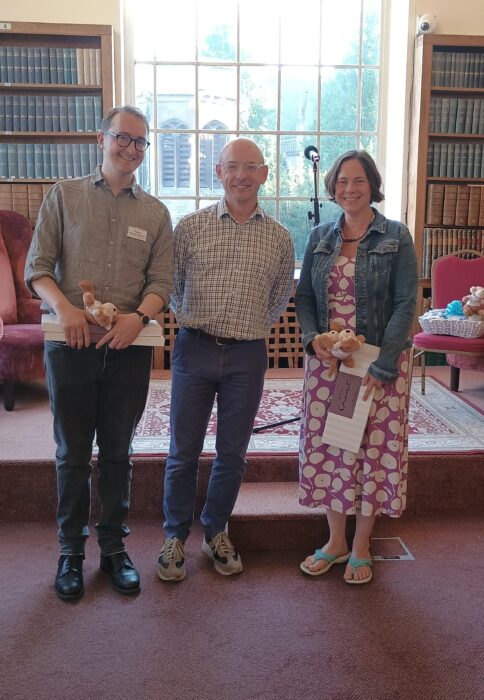
We had a fantastic evening taking part in the Ashtons Solicitors Charity Scavenger Hunt in Cambridge!
Melanie Benn, Quintin Langley-Coleman and Penny Grewcock explored some of the city’s hidden gems while helping raise over £4,000 for the Ashtons Charitable Trust; a brilliant initiative which supports community projects and local causes in the regions where Ashtons is based – including Norfolk, Suffolk, Cambridgeshire, and Leeds.
We’re also thrilled to share that Team Fenners took home first place! Thank you to Ashtons for organising such a fun and meaningful event, and to the Cambridge Union for hosting a lovely reception to finish off the evening.
The Cambridgeshire Local Family Justice Board and Fenners Chambers are delighted to invite you to the 2025 Family Law Training Day.
This in-person event will take place in the Engine Room at Sand Martin House and offers a valuable opportunity for professionals working in family justice to come together for a full day of updates, discussion and networking.
With contributions from members of the judiciary, leading barristers, medical experts and members from CFAB and CAFCASS, the programme will cover key issues in both public and private law, along with practical guidance on current challenges in the family courts.
Whether you’re looking to deepen your knowledge, hear directly from judges and experts, or simply reconnect with peers, this event offers valuable opportunities for all.
Attendance is free of charge and the event carries 5 CPD points. A networking lunch will be provided.
You can book your place by following the link here.
(Please note, as capacity is limited to 150, if your availabilities change please contact events@fennerschambers.com to cancel your ticket, so we can reassign it.)
___
Programme
9.30 – 10 Registration
10 – 10.45 Update on Public Law – Patrick Freer and Rebecca Clarke, Regency Chambers
10.45 – 11.30 Assessments of Family Members abroad – Speaker from Children and Families Across Borders
11. 30 – 11.45 Coffee
11.45 – 12.00 Current issues in the Public Law – HHJ Gordon-Saker DFJ
12.00 – 12.15 Police disclosure – Speaker TBC
12.15 – 1 Inflicted Head Injuries – Ibrahim Jalloh, Consultant Neurosurgeon (MEWA).
1– 2 Networking Lunch
2 – 2.45 Update on Private Law Children – Richard Balchin and Jeffrey Deegan, Fenners Chambers
3.50 – 4.05 Current issues in the Financial Remedy Court – HHJ Spinks
4.05 – 5.20 Update on Financial Relief – Laura McGinty and Joshua Walters, Fenners Chambers
Parking information
Sand Martin House multi-storey
Car park charges apply 24 hours per day.
7am to 8pm:
Up to 1 hour = £2.50
Up to 2 hours = £4.00
Up to 3 hours = £5.50
Up to 13 hours (weekdays) = £12.00
Post code: PE2 8TY – as you turn into Bittern Way, the new hotel is on the left (opposite the passport office), follow road past the apartments on the left, road bends to right and the multi story is immediately on your left.
Barrier controlled. Pay on exit. 14 blue badge spaces. Website says there are 4 charging points (I will look next time I go as not noticed them and I drive an EV!)
Exit the car park same end as lifts and you will be facing Sand Martin House.
Pleasure Fair Meadow
Car park charges apply from 7am to 8pm.
Up to 1 hour – £2.50
Up to 2 hours – £4.00
Up to 24 hours – £6.00
Postcode: PE2 9PB – Turn onto Oundle Road from the town centre end, and it is on your right.
Pay and display. No disabled spaces or chargers. 5 min walk
Riverside
Car park charges apply from 7am to 8pm.
Up to 10 minutes = no charge
Up to 1 hour = £2.20
Up to 2 hours = £3.50
Up to 3 hours = £4.50
Up to 4 hours = £6.50
Up to 13 hours = £8.00
Postcode: PE1 1EG – this is the car park in front of Peterborough Court so everyone should know this one. But if not, turn into road. Key Theatre on right, car park on left, follow road around to access.
Barrier controlled, pay on exit. 7 Blue badge spaces, 6 car chargers. 10-15 minute walk.
Car Haven
Car park charges apply from 7am to 8pm.
Up to 10 minutes = no charge
Up to 1 hour = £2.50
Up to 2 hours = £4.00
Up to 3 hours = £5.50
Up to 13 hours = £12.00
Disabled and Changing Places toilets facilities on-site
PE1 1YX – right in the centre of town and is a 15-20 minute walk.
Barrier controlled, pay on exit. 10 disabled spaces, 2 chargers.
Car park charges
Pay and display
Pay and display car park charges apply from 7am to 8pm.
You can make payments by:
Coins (no change given)
Credit or debit card (via Chip and PIN or contactless, including Apple and Google wave and pay)
If you pay by card at one of our pay and display machines, you can use this service – https://www.myparkingreceipts.co.uk/ – to look up your receipts or create an account so receipts are automatically emailed to you after you make a purchase.
Pay on exit
Pay on exit barrier-controlled car parks will require you to pay for parking when you are ready to leave the car park.
We use cookies on our website to give you the most relevant experience by remembering your preferences and repeat visits. By clicking “Accept”, you consent to the use of ALL the cookies. Read more about our privacy policy here
This website uses cookies to improve your experience while you navigate through the website. Out of these, the cookies that are categorized as necessary are stored on your browser as they are essential for the working of basic functionalities of the website. We also use third-party cookies that help us analyze and understand how you use this website. These cookies will be stored in your browser only with your consent. You also have the option to opt-out of these cookies. But opting out of some of these cookies may affect your browsing experience.
Necessary cookies are absolutely essential for the website to function properly. These cookies ensure basic functionalities and security features of the website, anonymously.
Cookie
Duration
Description
cookielawinfo-checbox-analytics
11 months
This cookie is set by GDPR Cookie Consent plugin. The cookie is used to store the user consent for the cookies in the category "Analytics".
cookielawinfo-checbox-functional
11 months
The cookie is set by GDPR cookie consent to record the user consent for the cookies in the category "Functional".
cookielawinfo-checbox-others
11 months
This cookie is set by GDPR Cookie Consent plugin. The cookie is used to store the user consent for the cookies in the category "Other.
cookielawinfo-checkbox-necessary
11 months
This cookie is set by GDPR Cookie Consent plugin. The cookies is used to store the user consent for the cookies in the category "Necessary".
cookielawinfo-checkbox-performance
11 months
This cookie is set by GDPR Cookie Consent plugin. The cookie is used to store the user consent for the cookies in the category "Performance".
viewed_cookie_policy
11 months
The cookie is set by the GDPR Cookie Consent plugin and is used to store whether or not user has consented to the use of cookies. It does not store any personal data.
Functional cookies help to perform certain functionalities like sharing the content of the website on social media platforms, collect feedbacks, and other third-party features.
Performance cookies are used to understand and analyze the key performance indexes of the website which helps in delivering a better user experience for the visitors.
Analytical cookies are used to understand how visitors interact with the website. These cookies help provide information on metrics the number of visitors, bounce rate, traffic source, etc.
Advertisement cookies are used to provide visitors with relevant ads and marketing campaigns. These cookies track visitors across websites and collect information to provide customized ads.










 The Cambridgeshire Local Family Justice Board and Fenners Chambers are delighted to invite you to the 2025 Family Law Training Day.